St Thomas More
Catholic Primary School
English


English at St Thomas More Catholic Primary School
At St Thomas More Catholic Primary School, English is central to pupils’ learning and underpins access to the whole curriculum. In line with the National Curriculum for English, we aim to promote high standards of language and literacy by equipping pupils with a strong command of spoken and written language, and by developing their love of literature. Through the teaching of English, we aim to develop confident communicators who can read fluently, write effectively and speak with clarity, while growing in faith and living out Gospel values.
Rooted in Catholic Social Teaching, we use English to promote dignity, justice and the common good by giving every child a voice and enabling pupils to communicate with respect, empathy and responsibility.
Our aims are to:
-
Ensure pupils develop competence in the four interrelated aspects of English:
spoken language, reading, writing, and spelling, punctuation and grammar (SPaG), in line with National Curriculum expectations. -
Enable pupils to read fluently, accurately and with good understanding, developing both word reading (including phonics) and comprehension skills.
-
Foster a love of reading through regular exposure to high-quality texts, including classic and contemporary literature, poetry, non-fiction and religious texts.
-
Develop pupils’ ability to write clearly, accurately and effectively, adapting language and style for a range of purposes, audiences and contexts.
-
Teach pupils to plan, draft, edit and evaluate their writing, building independence and resilience.
-
Ensure secure progression in phonics, spelling, grammar, punctuation and handwriting, appropriate to each key stage.
-
Develop pupils’ spoken language skills, enabling them to articulate ideas, participate in discussion and debate, and listen respectfully to others.
-
Provide opportunities for pupils to apply their English skills across the curriculum, including Religious Education, to deepen understanding and express ideas, beliefs and reflections.
-
Promote inclusive practice, ensuring that all pupils, including those with SEND and EAL, are supported to access the curriculum and make progress from their starting points.
-
Encourage pupils to use language to reflect, reason and respond, supporting both academic learning and personal development rooted in Gospel values.
-
Prepare pupils to become literate, articulate and responsible citizens, equipped for the next stage of education and life in modern Britain.
At St Thomas More, writing is taught through a structured, progressive and consistent approach, ensuring that pupils develop the knowledge, skills and confidence needed to write effectively for a range of purposes and audiences. Writing is carefully sequenced from the Early Years through to Year 6, in line with the National Curriculum for English.
Early Writing (EYFS and Year 1)
In Reception and the first term of Year 1, early writing is developed through:
-
Read Write Inc. Phonics, which teaches pupils to encode sounds accurately and apply phonics knowledge to writing.
-
Drawing Club, which develops oral storytelling, vocabulary, sentence structure and early composition through high-quality texts and imaginative experiences.
Pupils are encouraged to write independently during continuous provision, applying their developing phonics knowledge and forming letters correctly.
From Year 1, pupils continue with:
-
Read Write Inc. Phonics, ensuring secure application of phonics in spelling and sentence writing.
-
Curious Quest, which supports vocabulary development, sentence construction and early writing linked to meaningful contexts.
Writing from Year 2 to Year 6
From Year 2 to Year 6, writing is taught through a text-based curriculum, where carefully selected high-quality texts provide a model and stimulus for writing. Pupils are taught to:
-
Analyse model texts to understand structure, language and purpose
-
Develop vocabulary and grammatical knowledge
-
Plan, draft, edit and improve their writing
A wide range of genres is taught across the school, with progression in complexity and expectation as pupils move through the key stages.
Handwriting
Kinetic Letters is used consistently from Reception to Year 6 to develop fluent, legible handwriting. Teaching follows the four strands of the programme:
-
Making Bodies Stronger
-
Holding the Pencil
-
Writing the Letters
-
Flow, Fluency and Joining
This ensures secure letter formation, increased stamina and automaticity in handwriting, supporting pupils to write with confidence and accuracy.
Spelling
From Term 3 in Year 2 to Year 6, spelling is taught explicitly using Magic Spell, aligned with the National Curriculum spelling lists. Teaching focuses on:
-
Spelling rules and patterns
-
Word meanings and application
-
Regular revisiting to support retention
Spelling knowledge is applied within pupils’ independent writing across the curriculum.
1:1 RWI tutoring and small group interventions are used for pupils not yet ready to access Magin Spell.
Assessment and Adaptive Teaching
Teachers use ongoing formative assessment to inform planning and adapt writing lessons to meet pupils’ needs. Teaching is adjusted through:
-
Scaffolded support where required
-
Targeted intervention to address gaps in learning
-
Appropriate challenge to deepen understanding and improve outcomes
High expectations are maintained for all pupils, ensuring steady progress and increasing independence as writers.
Discreet grammar sessions are taught 3 x weekly. These are used to preteach or recap new learning.
Reading at St Thomas More
Reading is taught every day at our school and is at the heart of our curriculum. We intend for all learners to leave our school as confident readers with a love of books. EYFS and KS1 follow the RWI phonics scheme. Children are assessed every 6 weeks and grouped according to their ability at that point in time. These groups move fluidly throughout the year. In KS2 we follow a whole class reading approach. Since September 2020, we invested in quality texts for each year group, which we adapt each year according to trends and children’s interests. We carefully chose books that link in with curriculum themes for the term, are engaging and include rich vocabulary. Our primary focus is to model to pupils how to read and understand the text. We do this through echo reading, paired reading, identifying key vocabulary and class discussions. From these texts we write VIPERS questions for the children to answer. Throughout the week these will cover all strands to make the children confident to comprehend what they have read. In September 2021 we included factual, mathematical and poetry books into our reading sessions, focusing on these texts each term for a week each. We follow the same weekly pattern when reading these books. We incorporate reading into all of our subject areas encouraging children reading from the board, reading aloud and reading for pleasure and for knowledge. Any children that are lower ability readers or SEND are assessed using YARK, areas of weakness are identified and then interventions are put in place to help. If needed pupils in KS2 are also assessed using the RWI phonics assessment and are placed in groups for their ability. Any gaps in learning are identified through baseline and formative assessment. These gaps are filled through first quality teaching and through small group interventions.
Reading for pleasure has been a huge focus. We offer incentives for reading for pleasure, such as prize boxes and story sacks, dedicate time for it in school and all teachers read to the class every day. Any children that are not heard read at home or are our lowest 20% in the class will be heard read regularly in class. This could be by school staff, volunteer readers that come in each week and students from our local secondary school. Year groups take it in turns to visit our local library and take out books to read for pleasure. We also introduced ‘Race the Teacher’ which encourages the children to read more broadly at home. Each teacher picks a text each term to read for pleasure. The children join in at home and high quality discussions take place in school. In order to make reading for pleasure a higher profile in our school we have made our class reading corners more engaging and stimulating with forward facing books, have had our corridors and library painted in story book themes and purchased new books for the library.
Writing Curriculum Maps
- Faithful Foundations - Writing Curriculum Year One.pdfPDF File
- Faithful Foundations - Writing Curriculum Year Two.pdfPDF File
- Faithful Foundations - Writing Curriculum Year Three.pdfPDF File
- Faithful Foundations - Writing Curriculum Year Four.pdfPDF File
- Faithful Foundations - Writing Curriculum Year Five.pdfPDF File
- Faithful Foundations - Writing Curriculum Year Six.pdfPDF File
Reading Progression Lists
The children at St Thomas More make good progress in their confidence and enjoyment as readers and writers. Through a well-sequenced and consistently implemented curriculum, pupils develop the knowledge, skills and attitudes needed to read fluently, write effectively, and communicate confidently across a range of purposes and audiences.
As a result of our English curriculum:
-
Pupils read with fluency, accuracy and understanding, applying phonics, decoding strategies, and comprehension skills effectively.
-
Pupils write with increasing fluency, accuracy and stamina, applying spelling, grammar, punctuation and handwriting skills appropriately.
-
Reading and writing show clear progression in vocabulary, sentence structure, text organisation and comprehension from the Early Years through to Year 6.
-
Pupils can plan, draft, edit and improve their writing independently, demonstrating resilience and pride in their work.
-
Pupils make effective use of rich and ambitious vocabulary, drawn from high-quality texts and taught explicitly.
-
Handwriting is legible, fluent and increasingly automatic, enabling pupils to focus on content and quality of writing.
-
Disadvantaged pupils and pupils with SEND make strong progress from their individual starting points due to adaptive teaching and targeted support.
-
Pupils demonstrate a love of reading and writing, engaging with texts, expressing ideas, and reflecting on their learning with confidence.
-
Pupils use their English skills effectively across the curriculum, including in Religious Education, developing their ability to communicate ideas, reason and reflect.
-
Assessment outcomes show that pupils meet or exceed age-related expectations, with increasing numbers working at greater depth by the end of each key stage.
Through the English curriculum, pupils are prepared for the next stage of education, equipped with the literacy skills, confidence and independence to succeed as articulate, thoughtful and lifelong learners.
No Pens Day!


World Book Day in Year 2


Year 3 - World Book Day


Author visit from Sian Hughes, who wrote Betty and Toff and the puppy snatcher.


Reception celebrating World Book Day with costumes and pyjamas!


Our Amazing Writing


We celebrated World Book Day 2026 with an author visit, dressing up day and lots of reading!
Christmas 2025 Buddy Reading


All year groups had a super experience listening to authors at the Cheltenham Literature Festival


The author B.Ware came into school to share her latest book 'Warning, dragons can be dangerous'. B.Ware completed story writing workshops with classes and read from her book in an assembly. She also signed some books to add to our book corners.


During our narrative unit, Year 5 added words to the story 'The Snowman' by Raymond Briggs. They then continued the narrative in their own way. They shared their finished stories with the children in EYFS and Year 1.
Year 5 Experience Lesson - Scott of the Antarctic


english


Reading areas in the school
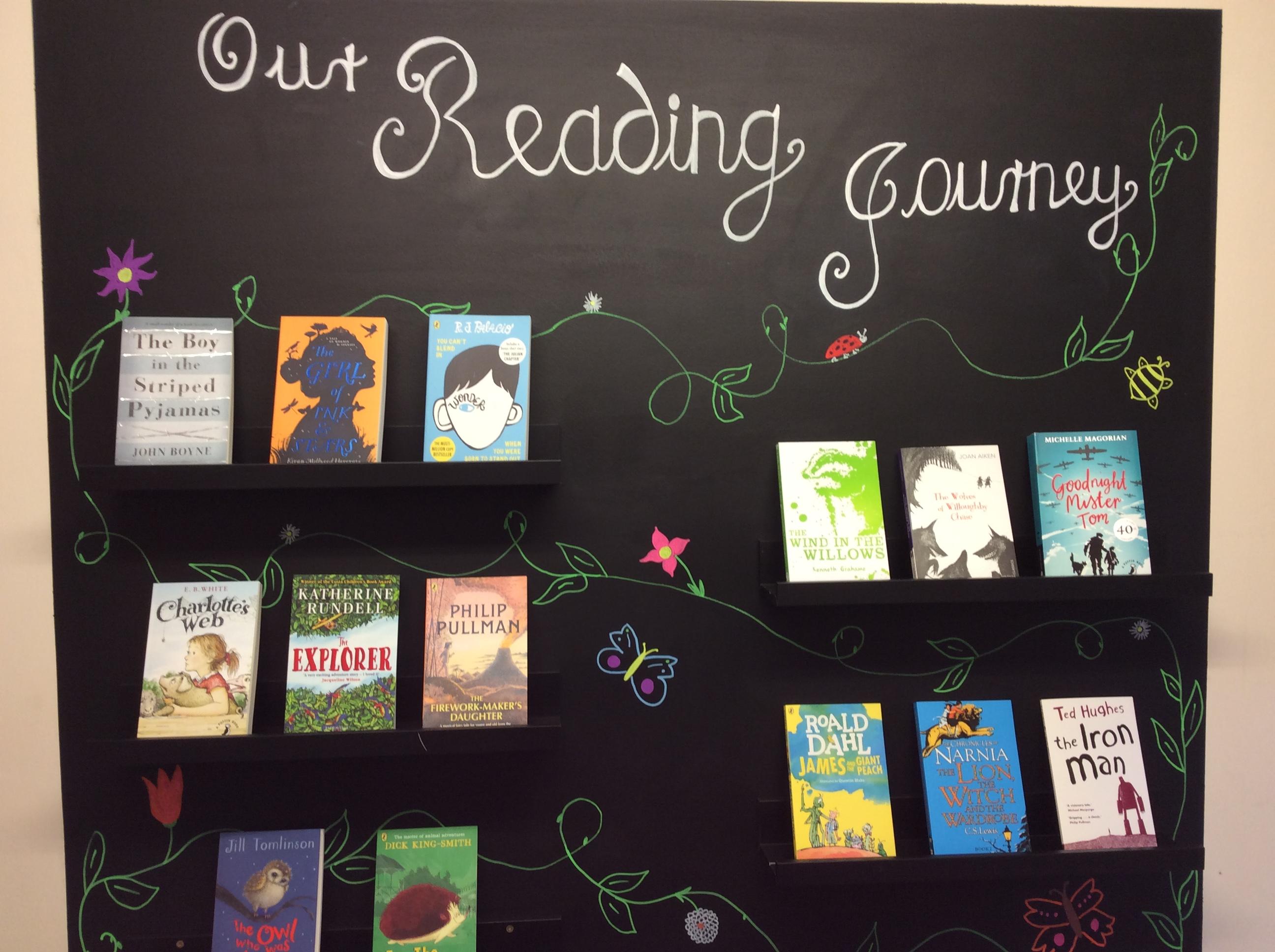
To foster a love of reading every classroom at St Thomas More Catholic Primary School has a comfortable and well resourced reading corner. To read not only for understanding but pleasure, children are encouraged to choose a book and enjoy reading a variety of genres as well as their age appropriate reading book and guided reading book. Our reading corners are adapted each term to match the whole class guided reading book that the children are reading.
To encourage a love of learning further, our recently refurbished library area has been restocked with a range of different books from a variety of genres, authors and cultures. This bright and welcoming communal area of space is enjoyed by many children whether in groups, for quiet reading or to even loan a special book linked to the classroom learning. Children across the school have the opportunity to borrow a book from the school library to keep in their drawers for use during guided reading. Classes also take it in turns each term to visit our local library to take out and return books.
Reading at home
All children take home a reading journal, along with their reading book, and this is a way of communicating with parents/carers about how well children are reading, how often and areas to work on. Pupils are encouraged to read at least 3 times a week and record this in their journal. Raffle tickets and rewards are given for reading at home. In addition to this, pupils in EYFS and KS1 take home story bags on a Friday to share with their families. These are handed out to one child each week in the class to celebrate their great reading that week.


